

SEO & Online Visibility
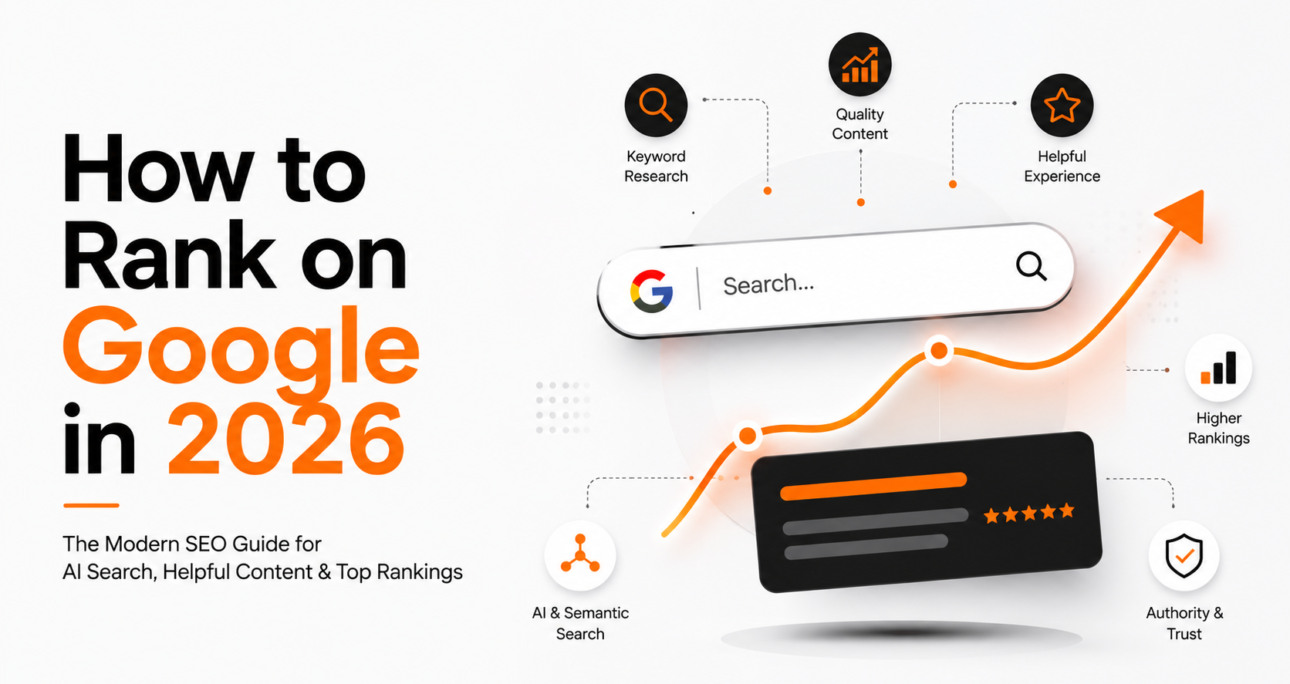
How to Rank on Google in 2026: SEO for Small Businesses
📅 June 2026
⏱ 7 min read
✍️ Socialnatics
If your business isn’t showing up on the first page of Google, you’re invisible to the majority of potential customers. Studies consistently show that over 90% of clicks go to results on page one — and the top three results alone capture more than half of all traffic.
The good news? You don’t need a massive budget to rank. What you need is a clear, consistent SEO strategy. In this guide, we break down exactly how small businesses in competitive markets can improve their Google rankings in 2026.
What Is SEO and Why Does It Matter?
SEO — Search Engine Optimization — is the process of improving your website so it appears higher in search results when people look for products or services you offer. Unlike paid ads, SEO traffic is free and compounding: the work you do today continues to drive visitors for months and years.
Key Stat
Organic search drives over 53% of all website traffic across industries. For local businesses, that number is even higher.
1. Start With Keyword Research
Before writing a single word of content, you need to understand what your customers are actually searching for. Keyword research reveals the exact phrases people type into Google when looking for a business like yours.
What to look for:
- High-intent keywords — searches that signal buying intent (e.g. “digital marketing agency Toronto”)
- Long-tail keywords — longer, more specific phrases with lower competition (e.g. “affordable social media management for restaurants”)
- Local keywords — your service + your city (e.g. “branding agency in Toronto”)
- Question-based keywords — how, what, why queries that you can answer with blog content
💡 Free Tool
Use Google’s free Search Console to see which keywords your site already ranks for. Then create targeted content around your best opportunities.
2. Optimize Your On-Page SEO
Once you have your keywords, you need to incorporate them naturally across your website. The most important places are:
- Page title (SEO title) — include your primary keyword within the first 60 characters
- Meta description — a compelling 155-character summary with your keyword and a CTA
- H1 heading — one clear heading per page that includes your target keyword
- First 100 words — mention your keyword naturally early in the content
- Image alt text — describe your images using relevant keywords
- URL slug — keep it clean and keyword-rich (e.g. /seo-for-small-businesses/)
3. Create High-Quality, Consistent Content
Google’s algorithm in 2026 rewards websites that demonstrate expertise, authority, and trustworthiness (known as E-E-A-T). The best way to signal this is through high-quality, regularly published content that genuinely helps your audience.
Aim for at least one blog post per week targeting a specific keyword. Each post should be a minimum of 800 words, answer a real question your customers have, and link to relevant pages on your site.
4. Fix Your Technical SEO
Even the best content won’t rank if your website has technical problems. The most critical technical factors to check are:
- Page speed — Google penalizes slow sites. Your page should load in under 3 seconds.
- Mobile-friendliness — over 60% of searches happen on mobile. Your site must work perfectly on phones.
- HTTPS — a secure site (green padlock) is a basic Google requirement.
- Structured data / Schema markup — helps Google understand your content and earn rich results.
- No broken links — 404 errors hurt both user experience and rankings.
5. Build Local SEO Presence
For any business serving a specific geographic area, local SEO is one of the highest-return activities you can invest in. Local SEO gets you appearing in Google Maps results, the “Local Pack” (the map with 3 listings), and location-based searches.
Your local SEO checklist:
- Create and verify your Google Business Profile
- Ensure your business name, address, and phone number are consistent everywhere online
- Collect Google reviews — they directly influence your ranking
- Create a dedicated city landing page (e.g. “Digital Marketing Agency in Toronto”)
- Add LocalBusiness schema markup to your website
Pro Insight
Businesses with 10+ Google reviews rank significantly higher in local search than those with fewer. Ask every satisfied client to leave a review — it’s free and powerful.
How Long Does SEO Take?
SEO is a long-term strategy. Most businesses start seeing meaningful results within 3–6 months of consistent effort, with significant growth by month 9–12. The brands that commit to it consistently are the ones that dominate their markets over time.
Need Help With Your SEO?
At Socialnatics, we build and execute SEO strategies that put your business in front of the right customers — consistently. Get a free proposal today.